ERP System vs CRM: What's the Difference and How Your Business Needs?
If you've been researching business software, you've probably come across both ERP and CRM, and wondered whether they're really that different or if one can replace the other. It's a question a lot of growing businesses ask, and the honest answer is: they serve very different purposes, even though they often work best together.
This article breaks down ERP system vs CRM in plain terms what each one does, where they differ, and how to figure out what your business actually needs right now.
What Is an ERP System?
ERP stands for Enterprise Resource Planning. At its core, an ERP application is a unified platform that connects the core internal functions of a business, finance, operations, inventory, procurement, HR, supply chain, into a single system with a shared database.
Instead of your accounts team working in one tool, your warehouse in another, and HR managing things in a spreadsheet, ERP systems pull everything into one place. The result is fewer errors, less double-handling, and much better visibility across the business.
Some of the key things ERP systems handle:
Financial management — accounting, budgeting, reporting, accounts payable and receivable
Inventory and supply chain — stock levels, purchasing, fulfilment, logistics
HR and payroll — employee records, leave management, payroll processing
Manufacturing — production planning, resource scheduling, quality control
Procurement — purchase orders, supplier management, spend analysis
The defining feature of a well-implemented ERP application is that it creates a single source of truth across your entire operation. Every team works from the same data, in real time.
What Is a CRM?
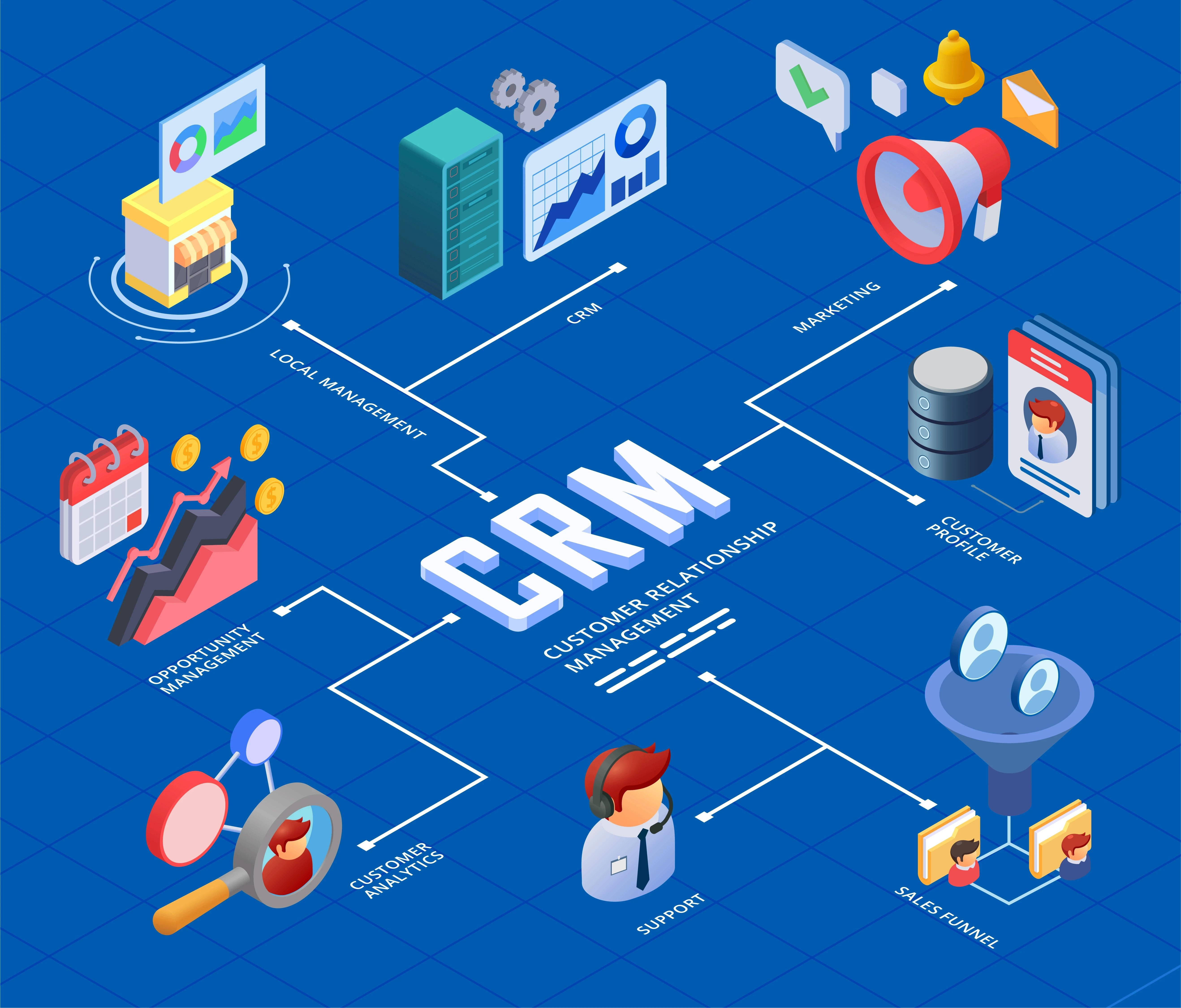
CRM stands for Customer Relationship Management. A business CRM is built around one thing: your relationship with customers — past, present, and prospective.
Where ERP systems look inward at your operations, a business CRM looks outward at your market. It gives your sales, marketing, and customer service teams the tools and data they need to attract, convert, and retain customers.
Core functions of a business CRM include:
Lead and pipeline management — tracking prospects from first contact through to closed deal
Sales automation — follow-up reminders, deal stage tracking, activity logging
Marketing tools — campaign management, email sequences, audience segmentation
Customer data management — contact records, interaction history, preferences
Customer support — ticket management, service history, case tracking
A CRM gives your front-facing teams visibility over every customer interaction, so nothing falls through the cracks and every conversation is informed by context.
ERP System vs CRM: Where They Actually Differ
The easiest way to understand ERP system vs CRM is to think about who each one serves and what part of the business it manages.
ERP Systems | Business CRM | |
Focus | Internal operations | Customer relationships |
Primary users | Finance, ops, HR, warehouse | Sales, marketing, support |
Data managed | Financial, operational, inventory | Customer, sales, engagement |
Goal | Efficiency and control | Revenue growth and retention |
Where it operates | Back office | Front office |
Both are built around data management, but the data they handle and the decisions they support are quite different. ERP systems make your operations leaner and more controlled. A CRM makes your customer-facing teams sharper and more effective.
That said, the line isn't always clean. A customer placing an order, for example, touches both systems — the sale is recorded in the CRM, while the fulfilment, invoicing, and inventory update happen in the ERP. This is exactly why many businesses end up using both, and why crm erp integration has become such a common requirement.
The Case for Running Both Together
When ERP and CRM systems are integrated, or when you use a platform that combines both something useful happens: you get a complete view of the customer journey from first enquiry right through to delivery, payment, and ongoing support.
Some specific advantages of running crm erp together:
Sales teams can see operational data. A sales rep can check stock levels or estimated delivery timelines without needing to call the warehouse. That speeds up conversations and reduces the risk of overpromising.
Finance teams get cleaner revenue data. When a deal closes in the CRM, it can automatically trigger invoicing and revenue recognition in the ERP, no manual re entry, no reconciliation headaches.
Customer service gets context. Support staff can see whether a customer has outstanding invoices, previous orders, or open service tickets all in one place, rather than jumping between systems.
Management gets a real picture. When your ERP systems and CRM are sharing data, reporting becomes significantly more useful. You're not just looking at revenue numbers in isolation, you can see how sales performance connects to operational capacity, margins, and customer lifetime value.
So Which One Does Your Business Need?
This is where it helps to be honest about where your business is and what's causing the most friction.
You probably need a business CRM first if:
Your sales process is disorganised leads are tracked in spreadsheets or lost entirely
Your marketing team has no clear view of what campaigns are working
Customer follow-up is inconsistent and relies on individuals remembering to act
You're growing your sales team and need standardised processes
You probably need ERP systems first if:
Your financial reporting is slow, manual, or unreliable
Inventory management is causing stockouts, write-offs, or fulfilment errors
You're running multiple systems that don't talk to each other
HR and payroll processes are eating up admin time that could be used elsewhere
You're scaling operations and the cracks are showing
You likely need both if:
You've outgrown basic accounting software and a simple CRM at the same time
You want a single platform where every part of the business is connected
You're dealing with reconciliation issues between your sales data and financial data
You have growth targets that require more operational discipline and more commercial focus simultaneously
The truth is, for most businesses past a certain size, erp system vs crm isn't really an either/or question. It's a sequencing question, which do you tackle first, and how do you build toward a connected system over time?
A Note on CRM Inside ERP
Some ERP platforms include a built-in CRM module, which can be a good option for businesses that want both capabilities in a single environment. The advantage is tighter data integration and fewer moving parts to manage.
The trade-off is that the CRM functionality inside an ERP application is sometimes less specialised than a dedicated business CRM. Whether that matters depends on the complexity of your sales and marketing operations. For businesses with straightforward customer management needs, an integrated approach often works well. For businesses with complex sales cycles or large marketing operations, a dedicated CRM alongside a robust ERP system tends to deliver better results.
What Exo Digital Sees in Practice
Working with businesses across different industries, we see the same pattern regularly. Companies invest in a business CRM early, which makes sense, because sales visibility is an obvious need and then struggle as they scale because their back-office systems can't keep up.
Orders are tracked manually. Finance teams are still reconciling data between different tools. Inventory decisions are being made on gut feel rather than real-time stock data. The business is growing, but the operational foundation isn't keeping pace.
That's the moment when a properly implemented ERP application becomes less of a "nice to have" and more of a genuine business requirement. And it's the point where getting the implementation right rather than just picking a platform really matters.
Ready to Get Your Operations Under Control?
If you're finding that your business has outgrown its current systems, whether that's spreadsheets, disconnected software, or a basic accounting tool, it might be time to look seriously at a purpose-built ERP solution.
Exo Digital's ERP Solutions are designed for businesses that need more than a generic platform. We work with you to understand your operations, configure a system that fits your workflows, and implement it in a way that actually sticks.
Read Too: What Is ERP Implementation? A Complete Guide for Businesses